
Latin America's trade finance sector is growing fast, and the professionals rising with it are the ones who've invested in the right knowledge.
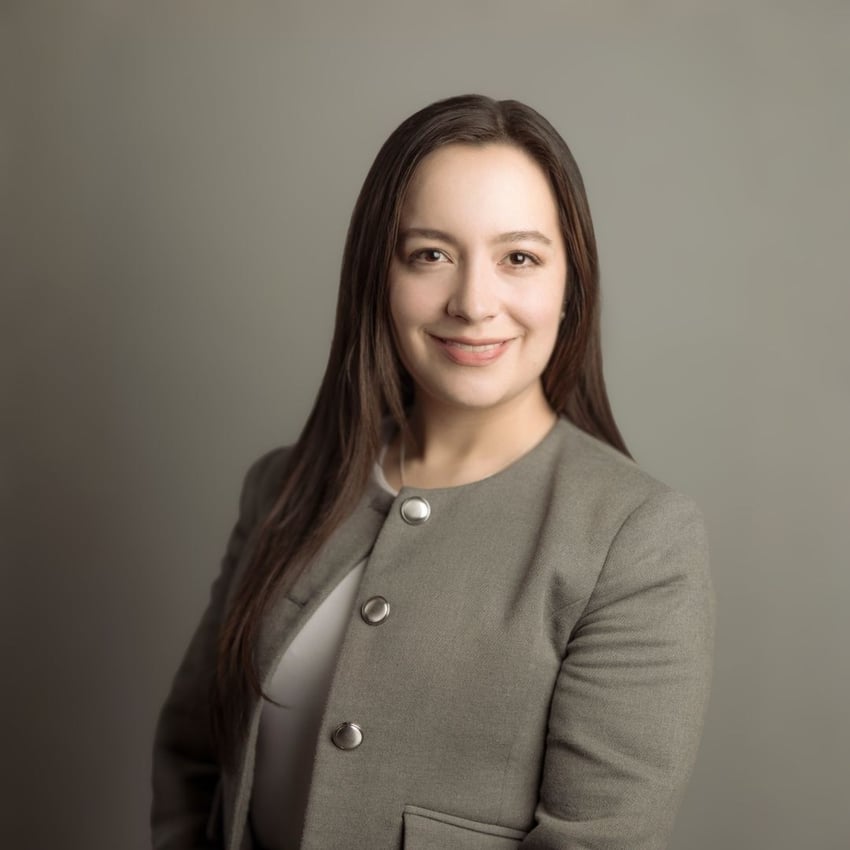
Mónica Tapia is one of those rising professionals. She joined Banco Pichincha as a trainee, earned the Certificate for Documentary Credit Specialists (CDCS) with LIBF (Part of Walbrook Institute London), and recently stepped into a Corporate Business Officer role.
You can read Mónica's career story below or listen to it being read out by AI narration.
Can you tell us a bit about yourself and your current role in international trade?
I am Mónica Tapia, a specialist in finance and economics from the University of Toronto. I work at Banco Pichincha, the biggest financial institution in Ecuador. I used to work in the international trade department as an international trade specialist, but one month ago I was promoted to Corporate Business Officer.
How did you first get into banking and international trade?
Interestingly, my banking career began in international trade. Back in 2020, after completing my degree in Canada, I came back to Ecuador. I was looking for job positions and one that caught my attention was a trainee role at Banco Pichincha. At first I didn't know which area I was going to be assigned to, and after my first day of induction they placed me in the international trade department. That was my first-hand exposure to exporters and importers, and to the complexity of international transactions and the role banks play in mitigating risk and enabling global commerce.
How did you first hear about LIBF, and what convinced you it was the right choice for your studies?
I first heard about LIBF through my institution, which was actively promoting professional development within the international trade team. The CDCS was recommended because of its strong international recognition and the fact that it is directly aligned with the regulations and practices we apply in our day-to-day work. I completed the Certificate for Documentary Credit Specialists in 2024.
Does Mónica's story inspire you to study with LIBF?
Take control of your career today:
-
Develop skills you can apply immediately
- The CDCS is 100% online and designed to fit around your career
Can you talk us through your career journey so far?
I started my career as a trainee in the international trade department, which was also my first exposure to banking. During that stage, I built a solid foundation in trade operations, documentation, and the wide variety of products available to mitigate risk or finance international trade operations. I then progressed to a corporate officer role, where I worked directly with corporate clients and gained a broader understanding of their financing needs and risk profiles. That experience allowed me to combine client-facing responsibilities with technical trade knowledge. Currently, I work as an international trade specialist, focusing on structuring trade finance solutions, managing complex transactions, and supporting clients in their cross-border operations. Each role has helped me develop both technical expertise and a stronger strategic perspective on international trade.
What does a typical day look like for you in your role at Banco Pichincha?
A typical day is a combination of commercial and operational responsibilities. On the commercial side, I work very closely with clients and visit them regularly to better understand their businesses, identify their needs, and advise them on the most suitable products within the international trade portfolio. On the operational and technical side, I leverage my knowledge of trade finance regulations and product structures to properly structure transactions, ensuring they are compliant, efficient, and aligned with both the client's needs and the bank's risk framework. This balance allows me to add value both as a client adviser and as a technical specialist.
What is it like working and studying in Ecuador?
Working full time and studying in Ecuador has been both very challenging and very enriching for me. Because the country relies heavily on international trade, while I was studying I was exposed to real cross-border transactions, which made learning much more meaningful – I could immediately apply what I was studying to my daily work. Balancing work and studies also taught me discipline and time management.
How would you describe the trade landscape in Ecuador from your perspective inside the bank?
Ecuador, as a dollarised country, depends heavily on exports to generate foreign currency. Exports are quite concentrated in sectors such as oil, bananas, shrimp, cacao, and flowers, though in recent years we've seen a significant increase in non-oil exports.
As a bank, we focus on becoming a strategic partner for exporters by providing practical solutions such as pre-export financing, discounting, and confirmed letters of credit – tools that are critical to keeping their operations running. This support directly contributes to business growth, export diversification, and economic development.
On the import side, Ecuador brings in goods that mainly support production and consumption – machinery and industrial equipment, raw materials, vehicles and auto parts, pharmaceuticals, and technology. We've identified the importance of providing financing solutions and risk mitigation tools to help these companies operate smoothly and with confidence.
A globally respected qualification
As the CDCS editor, I’ve aimed to ensure the programme delivers comprehensive knowledge of documentary credits, equipping professionals with the expertise and global recognition they need to excel. This qualification not only enhances career prospects but also demonstrates a deep commitment to professional development in trade finance."
Gary Collyer
CDCS editor and trade finance expert
When you decided to take on a professional qualification, how did you find fitting study around a full working day?
It required a lot of discipline and strong time management. After working a full eight-hour day in international trade, coming home to study the same subject was definitely exhausting at times. It also required the support of my family, as I spent less time with them during that period. What kept me motivated was being able to directly relate what I was studying to the real cases I was handling at work. That connection made the learning process much more engaging and interesting, and it encouraged me to keep going.
What helped me the most was establishing a clear routine and a structured study plan. On weekdays, I dedicated around two hours every evening after work to studying, and at weekends that increased to about four hours per day. Having this consistency helped me stay disciplined. I also closely followed the study guide provided in the course manual, which was very helpful because it clearly outlined the topics that needed to be covered each week. This structure made the workload manageable and allowed me to cover everything.
How did your understanding of international trade evolve as you started to connect what you were learning with your day-to-day responsibilities?
My understanding of international trade changed significantly once I began connecting what I was learning with my day-to-day responsibilities at the bank. At first, international trade concepts felt theoretical and rule-based – focused on frameworks like Incoterms, UCP 600, or payment methods. But as I started applying them in real transactions, I realised that trade is much more practical, contextual, and risk-driven. Every transaction has its own commercial reality, and the same instrument can be used very differently depending on the client, the market, and the level of risk involved. Connecting theory with daily practice transformed my perspective. International trade became less about following rules and more about structuring transactions that work in real business conditions, where the bank plays an active role as an adviser and strategic partner rather than just a transaction processor.
Accomplishing the CDCS through effort, dedication, and consistency has been incredibly motivating. It reinforced my belief that with the right mindset and continuous learning, we can achieve what we set out to do."
You work in a team of very experienced colleagues – what did gaining your certification mean for your confidence at work?
Working alongside very experienced colleagues, obtaining the certification significantly increased my confidence at work. It validated the knowledge I had built through experience and gave me a stronger technical foundation to contribute more actively to discussions and decision-making. I felt more confident when advising clients, structuring trade finance solutions, and supporting complex transactions. The CDCS certification helped me feel more comfortable expressing my opinions and adding value within the team.
What has been the most rewarding part of your journey so far?
Looking back, what has felt most rewarding is knowing that I achieved the certification despite having less experience than what is typically recommended. While the guidance suggested a minimum of three years of experience, I had only two at the time. That challenge pushed me to work harder, stay disciplined, and remain committed to my goal. Accomplishing the CDCS through effort, dedication, and consistency has been incredibly motivating. It reinforced my belief that with the right mindset and continuous learning, we can achieve what we set out to do. This is what motivates me to keep developing my skills and growing professionally in international trade.
You work with both large and small clients – what do you enjoy most about supporting smaller companies that are new to international trade?
Large companies and corporations usually have dedicated international trade teams that support them in negotiations and in choosing the appropriate products. Smaller companies, on the other hand, are often just starting out and may not yet have the technical knowledge or experience in international trade. What I enjoy most about supporting these smaller businesses is guiding them through the available tools and helping them understand how to structure their transactions properly. Being able to educate and advise them so they can negotiate with more confidence is very rewarding, because it gives me a sense that I am contributing not only to their growth, but also to the economic development of my country.
How has studying with LIBF supported your professional development in international trade?
Studying with LIBF has strongly supported my professional development in international trade by providing a solid, internationally recognised technical foundation with the CDCS. The programme allowed me to deepen my understanding of trade finance rules, best practices, and risk mitigation, and to apply this knowledge directly to real transactions in my day-to-day work. It also increased my confidence when advising clients and working alongside experienced colleagues, as it validated my practical experience with formal, structured learning. Overall, the qualification has helped me grow both technically and professionally in a highly specialised field.
The qualification that goes to work with you
Mónica's journey from trainee to Corporate Business Officer is a positive reminder of what focused professional development can achieve. Mónica built her expertise transaction by transaction, and earned the CDCS with LIBF while working full time – and it changed everything around her. Her clients trust her more and the businesses she supports across Latin America are better equipped to trade internationally because of it.
The CDCS is the global benchmark for documentary credit expertise. If Mónica's story has resonated with you, it could be your next step too.
Try our online programmes that fit around your commitments
It can be very demanding to study alongside a full-time job, but the knowledge and skills gained from studying for qualifications like CDCS and CITF are highly beneficial and directly applicable to our work. It’s a worthwhile investment."
Reem Samawi
Head of Trade Finance Transactions | Cairo Amman Bank