
This article originally appeared in Financial World, which is available free to LIBF members. You can read the full piece by logging in via Brightspace.
As part of our series of ‘what is…?’ explainers, we take a look at why businesses trade and at what tariffs are
Businesses make money by selling products and services at a price higher than their input costs. No surprises there. Further, given that the margin firms can command is limited by the amount that customers will pay, and usually by competition, having as large a customer base as possible is generally a good idea.
There are some exceptions to this. Luxury goods – so-called Veblen goods – can charge higher margins as their price goes up. Customers will spend more on luxury items like high-end watches because their relative scarcity makes them status symbols. So-called Giffen goods – essential goods that can’t be substituted with something else, examples are foodstuffs like wheat – also see rising demand as their price rises.
Why engage in international trade?
But how do firms producing neither luxury nor non-essential goods cut input costs and increase their customer base? For many, this is done via international trade.
There are a number of reasons why companies trade. Access to raw materials, technologies or skills that are not available in the domestic market, or only at a higher price, is an important driver – especially in a globalised economy. Decreased competition, too, is important: what a firm is offering may be novel and relatively prized in another country. Think of Italian pasta in the UK, or British cheddar in France. Other drivers of trade include improved risk management, because globalised firms are less dependent on one market or one supply chain, foreign exchange benefits, and extending the life-cycle of a product which is familiar at home but new elsewhere.
Comparative advantage
Underpinning all of these trade benefits is the concept of ‘comparative advantage’. No one country can provide all of the goods and services that its population wants and needs, and some countries will be better at producing a particular good or service than another. The United Kingdom, for example, imported £58.7 billion worth of computer, electronic and optical products in 2024. It imports them because it cannot produce them in the quantities and at the price that other countries can. Even a country as large as the United States imports many goods and services – both those that are simply cheaper when bought abroad, as well as those that are not available on domestic markets – from countries that have a ‘comparative advantage’ in their provision. Ninety percent of the world’s high-end computer chips used by US tech firms are manufactured in Taiwan, for example, which is a cheaper manufacturing hub than the US. (‘Comparative advantage’, which relies on specialisation and on the division of labour, was first outlined in 1817 by David Ricardo, who wrote about it in On the Principles of Political Economy and Taxation.)
Another example of comparative advantage is the distributed global production of the iphone. Though the iphone is designed in California, “substantially all” of Apple’s hardware products are manufactured by outsourcing partners located primarily in mainland China, in India, Japan, South Korea, Taiwan and Vietnam. It is cheaper to make the iphone in Asia than in the US, even allowing for costs such as shipping, managing complex supply chains and foreign exchange, mainly because Asian workers earn much less than those in the US. In 2025, Apple had a total gross margin on its products and services of 46.9%. Within that, services had a gross margin of 75.4% and products of 36.8%, according to Apple’s annual report.
Tariffs and trade deficits
But even companies with margins as large as Apple’s have to continually monitor their cost base. Until the election of Donald Trump as US President in 2016, tariffs – that is taxes paid by importers on the goods they bring into a country – were low for US imports, averaging 2.2%.
That is because multilateral trade agreements grew out of the Global Agreement on Tariffs and Trade (GATT), which was signed in 1947 and part of the post-war drive to prevent a repeat of the mistakes that had led to the global conflict. The first article of GATT is the principle of ‘most favoured nation’ status under which any trading privilege given to one country has to be immediately made available to all GATT signatories. China gained ‘most favoured nation’ status when it joined the World Trade Organisation in 2001.
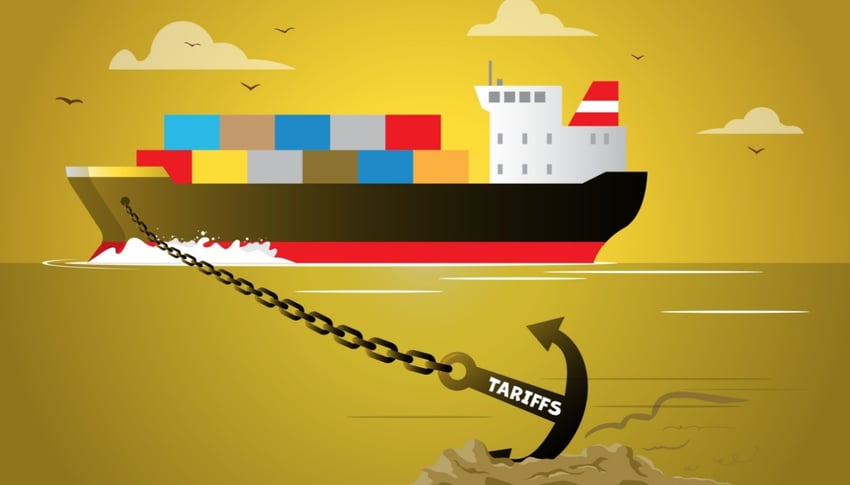
Trump introduced protectionist tariffs on imports, particularly those from China, in 2018/2019, which led many Chinese firms to set up manufacturing plants overseas. Since then, the trade wars have escalated and, on 2 April 2025 (so-called ‘liberation day’), Trump announced the imposition of a universal 10% tariff on all goods imported into the US as well as specific tariffs on some countries. There has been horse trading around the specifics since then, which was upended when the Supreme Court found on 20 February 2026 that Trump had overstepped his powers in imposing those tariffs, which were based on the 1977 International Emergency Economic Powers Act (IEEPA). Trump responded by announcing that he would use Section 122 of the 1974 Trade Act to impose 15% tariffs on all countries exporting to the US.
How this latest announcement will play out in practice remains to be seen, as manufacturers and other jurisdictions decide on their response. The UK has said that ‘nothing is off the table’.
Trump’s stated rationale for imposing tariffs is that other countries are taking advantage of the US. Any trade deficit – ie any instance in which the US imports in overall dollar terms more from a particular country than it sells to it – is, in Trump’s view, a sign of failure. However, access to cheap imports from China cut inflation for US consumers. Further, the US trade deficit is driven by US demand for overseas goods, and tariffs have not reduced that. The US trade deficit in goods widened to a new record in 2025.
Trump argues that tariffs will encourage the reshoring of manufacturing to the US. Tariffs paid by importers will, also, raise large amounts in taxes though these are, ultimately, paid by US consumers. The reason is that if companies have sufficient pricing power they will pass on the costs.
Tariffs can have profound implications for firms, even those that offer highly-sought-after products. When the ‘liberation day’ tariffs were announced, for example, it was estimated that Apple would need to increase the cost of an iphone in the US by 9% to offset the tariff costs. Imports of iphones to the US were later exempted from tariffs.
Do tariffs protect manufacturing jobs?
According to the economic research paper ‘The China Shock: Learning from Labor-Market Adjustment to Large Changes in Trade’, between 1999 and 2011, increased imports from China went hand in hand with the loss of nearly 1 million manufacturing jobs and nearly 2 million job displacements in the US. However, economists dispute the argument that tariffs would have protected US manufacturers. The main driver of job losses was, they say, automation.
Imposing tariffs is also not expected to enable a resurgence in manufacturing in the US, primarily because manufacturers themselves rely on imports that are made more expensive by tariffs.
The Federal Reserve Bank of New York estimates that the average tariff rate on US imports increased from 2.6% to 13% in 2025. The Tax Foundation, a Washington DC-based think-tank focused on US tax policy, found that increased tariffs on goods cost the average American household $1,000 in 2025.
If you would like to learn more about global trade, The Certificate in International Trade and Finance (CITF) provides a detailed understanding of the products, documents, trade terms, roles and responsibilities that underpin trade finance. Every year, hundreds of people around the globe take CITF to help launch their career in trade finance and hundreds more use the qualification to demonstrate the knowledge they have gained during their career. The Trade and Transaction Banking team is happy to help with any queries and can be contacted at: trade@libf.ac.uk