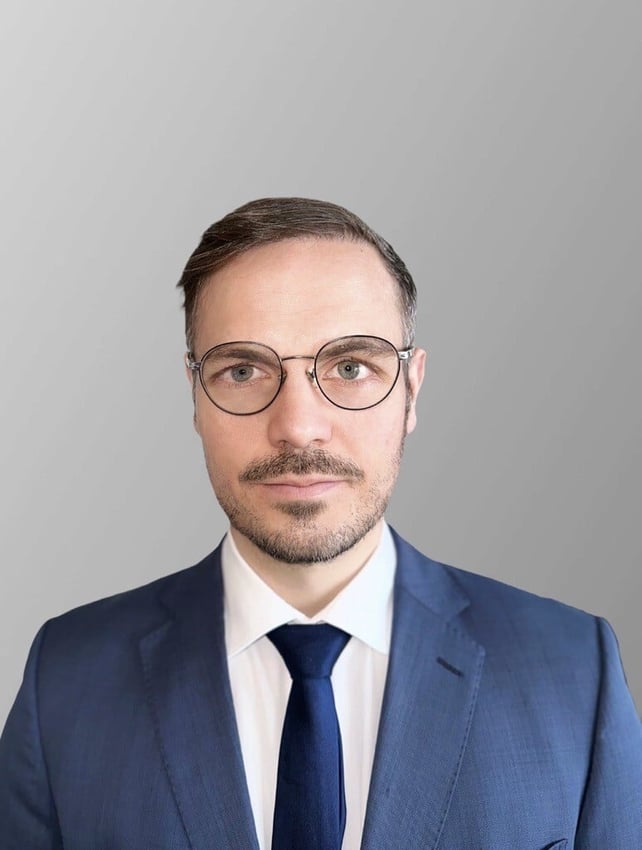

What if the secret to a long and successful career in trade finance wasn't avoiding risk but learning to understand it deeply enough to use it to your advantage?
Alexander Loszinski has spent his career doing exactly that. From an apprenticeship at Commerzbank in Germany to a senior role at Munich Re, one of the leading reinsurers globally, Alexander's journey through trade finance is one of continuous growth, deliberate learning, and a healthy respect for complexity. We sat down with him to find out what it really takes to build a trade finance career and why the qualifications he earned along the way proved to be far more than just certificates.
What initially sparked your interest in trade finance?
What initially drew me to trade finance was its direct connection to the real economy. In this field, finance is tangible: goods move, projects are built, factories operate. I was motivated by the fact that my work had a visible and measurable impact. Over time, this perspective expanded from individual companies to entire regions. Today, through my involvement with development banks - particularly in Africa - I see first-hand how trade finance can support economic growth at a macroeconomic level.
How did your career in trade finance begin?
My professional journey began with a traditional banking apprenticeship at Commerzbank, which provided me with a solid foundation across operations, sales, and core banking functions. Alongside my bachelor’s and master’s studies, I remained professionally active, allowing theory and practice to reinforce one another.
I subsequently moved into trade finance sales for small and medium-sized enterprises by providing advisory services throughout a substantial portion of the province north of Frankfurt.
Thereafter, in my capacity as Relationship Manager for trade finance-focused financial institutions in Pakistan and Malaysia, I engaged closely with local banking professionals and clients.
These experiences afforded me profound insights into the strategic outlook of such banks regarding trade finance and the cultivation of enduring client partnerships across diverse markets and cultures.
One of the most formative stages of my career was leading trade finance sales for a major Italian banking group across the DACH region. Operating effectively as a one-man setup, I was responsible for client acquisition, structuring, execution, and delivery. This experience sharpened my entrepreneurial mindset, resilience, and ability to prioritize under pressure.
A later move to the corporate side marked a decisive shift in perspective. Working within a treasury function exposed me to balance sheet optimization, cost efficiency, and the automation of trade finance processes.
Ultimately, my transition to Munich Re brought my career full circle. In my current investor-side role, I now assess trade finance risk from a holistic perspective that connects banks, corporates, and capital markets.
Does Alexander's story inspire you to study with LIBF?
Take control of your career today:
-
Develop skills you can apply immediately
- Our programmes are 100% online and designed to fit around your career
What motivated you to start closing skills gaps with professional qualifications?
For me, these certifications were never just an end in themselves. They were practical tools that helped me speak the different “languages” of risk, sales, and operations precisely and confidently. Especially in relationship management roles and sales, you often serve as a bridge between clients, risk teams, and internal operations. It’s essential to understand the specific terminology and processes - particularly since the jargon can vary from organisation to organisation, even when describing the same trade finance products or techniques.
Since I work with a wide range of clients, products, and structures, expanding my expertise was crucial for adapting flexibly to various demands - whether advising on large-scale industrial trade finance projects or structuring complex commodity transactions. These qualifications gave me the assurance and technical confidence to engage with clients, risk specialists, and decision-makers on equal footing, both technically and commercially.
Why did you choose LIBF for professional development?
Choosing LIBF was straightforward because their certifications are globally recognised and highly practical. They not only provide theoretical knowledge but also deliver frameworks that I could apply directly in my daily work.
Why is risk part of the trade finance world?
Trade finance is fundamentally built on risk. A significant share of global trade relies on banks assuming and mitigating credit, country, operational, and political risks on behalf of corporates. As regulatory requirements have intensified, many banks have reached their internal capacity limits -particularly with regard to credit exposure.
This development has led to the emergence of a dynamic secondary market, in which risks are actively transferred and shared among banks, insurers, and investors. Without this ecosystem, many large-scale trade flows - especially in commodities and emerging markets - would simply not be feasible.
How did your perspective on risk change as your career advanced?
Early in my career, I viewed risk primarily as something to be identified, measured, and controlled. Over time, this perspective evolved fundamentally. Today, I see risk as a structurable and transferable asset that can be optimised across balance sheets and institutions.
In my current role, risk is no longer confined to a single balance sheet. Instead, it is orchestrated across the entire value chain, linking corporates. originating banks, syndication partners, and investors. When aligned effectively, this approach allows capital to be deployed more efficiently and sustainably.
Are you ready to challenge the status quo?
I recommend LIBF qualifications because they provide you with extensive knowledge in different trade finance areas. I like most that I can study anywhere, at any time."
Mohamed Montaser
Trade Finance Manager at Al Ahli Bank of Kuwait
How do you handle the pressure of risk management?
As my responsibilities increased, so did the pressure associated with decision-making. What once felt personal and burdensome gradually became manageable through experience, disciplined processes, and clear communication. Having worked across banking, corporate treasury, and investor environments, I understand where tensions typically arise and how they can be addressed early.
Today, I actively share these experiences with younger colleagues, supporting them in navigating complex risk situations with confidence rather than stress.
Does great risk come with great reward?
Does great risk come with great reward? I would say absolutely. So in my experience, especially now being at a leading reinsurance company, the greatest rewards often come from managing risks in unconventional ways. And what do I mean with that? I would say some of my most satisfying deals were those others considered impossible.
I quite like it when people see transactions or deals impossible because when people say "it can't be done," and suddenly you find the right structure and balance between the exposure and opportunity, that's when the connection between risk and reward truly comes alive.
Continuous learning is indispensable — it drives both business growth and personal career advancement. I highly recommend working with LIBF."
What has been the most rewarding part of your career?
You grow by the challenge, and in my case I was looking for something bigger. I was looking for more responsibility, and I challenged myself intentionally. While I developed internally on the bank side, there comes a point when you must take a leap and embrace new challenges in different work environments. That’s exactly what I’m doing today. The most rewarding moment of my career came when I began building relationships with development banks. Working with large capacity and collaborating on meaningful transactions that are fundamental to certain countries truly amplifies the sense of purpose. Each time we successfully complete such a project, the positive impact on the world becomes clear, and the sense of accomplishment grows stronger.
How do you measure the positive impact of your work?
Fundamentally, I work for a commercial company, and naturally, my performance is measured by our profit and loss. Yet what matters even more, I believe, is what we undertake on a silent basis. Often, when I open a newspaper and read about developments in countries where trade finance is essential, I see the risks we help to mitigate, particularly in developing markets. These are considered high-risk environments, and our ability to provide capacity for crucial goods - oil, wheat, palm oil, and others - directly supports the needs of societies and fosters economic growth within those regions.
When I see positive progress reported, it affirms the impact of the work - work that is conducted quietly, on a silent basis. Such moments give me the sense of fulfillment I seek in my profession, and I find genuine satisfaction in these results
What motivates you to keep learning?
Learning is something you do continuously and it's something that is good and improves you. And in order to stay ahead of everything, I think that's a crucial element. And that's basically where I take my strengths from and that is basically what helps me drive my business here in trade finance.
Would you recommend LIBF to others?
Yes I do because it helped me throughout my career. The first certificate I've done with LIBF was probably 10 years ago. I started with CITF to give me a broader understanding. Over time, I pursued further qualifications whenever I identified a knowledge gap or felt compelled to deepen my expertise. Continuous learning is indispensable — it drives both business growth and personal career advancement. I highly recommend working with LIBF.
Take the risk out of your career advancement
Alexander's story is a compelling reminder that professional qualifications aren't just about adding letters after your name. They're about walking into any room - whether it's a client meeting, a risk committee, or a development bank boardroom - and knowing you can hold your ground, technically and commercially.
If you're looking to build that kind of confidence, LIBF offers a suite of globally recognised trade finance qualifications designed to take you from foundation level right through to specialist expertise.
Ready to take the next step? Discover your potential with LIBF.
Try our online programmes that fit around your commitments
That’s the best thing about LIBF – managing studying alongside work. It was structured in a flexible way that I meant if I wanted to get ahead, I could. If I fell behind, I could catch up."
Sonny Kurmi
LIBF Learner