
Technology alone doesn't deliver real transformation
Technology now underpins how almost every organisation operates. At the same time, newer technologies such as cloud platforms, automation tools and artificial intelligence (AI) are becoming increasingly prominent on strategy agendas. Yet for most companies and public bodies, adopting and implementing the technology is the easy part. Turning it into real, lasting transformation is where things fall apart.
This gap is not a rumour. It is measured, documented, and remarkably consistent across sectors and countries - including here in the UK.
About the experts:
Dr Vikram Finavker is Academic Lead for Management at Walbrook Institute London, and Yelena Khegay is Deputy Programme Lead for the Online MBA.
Vikram holds a PhD in Finance and specialises in finance, investment, risk management and business strategy. Yelena is a Fellow of the Higher Education Academy with over 10 years’ experience in higher education, combining expertise in accounting and finance with experience teaching and leading across strategy, business and management.
The problem is rarely the technology itself. Organisations tend to underestimate the changes in leadership, accountability, skills and ways of working needed to turn adoption into measurable results.
The evidence: everyone is experimenting, few are transforming
McKinsey's State of Organizations 2026 report puts the problem in stark numbers. Adoption of AI is now widespread with 88% of organisations are using it in some part of the business. But just as many, 81%, report no meaningful bottom-line impact from it. In the US, only 1% of C-suite leaders describe their generative AI rollout as “mature,” and one in six organisations has nobody senior actually accountable for AI adoption (McKinsey & Company, 2026).
Digital transformations frequently underdeliver. In a survey of 1,700+ C-suite executives, McKinsey found that the average digital transformation had a 45% chance of delivering less profit than expected, and only a 1-in-10 chance of beating expectations. Yet the top 10% of digitised incumbents captures up to 80% of digital revenue in their industries leading to a stark gap between winners and laggards (Bughin, Deakin and O'Beirne, 2019). A 2024 BCG study adds a third, independent data point to this picture: only 30% of companies fully meet the timeline, budget, and scope expectations of large-scale tech program implementations, with overall transformation success rates stagnating at around 30–35% (Hamane, Burchardi and Singh, 2026).
The UK's own evidence tells a similarly sobering story, and government has been documenting it for years, well before the current AI wave. The Department for Science, Innovation and Technology's State of Digital Government Review found that 47% of central government services still lack a proper digital pathway, and an estimated £45 billion a year in productivity benefits goes unrealised because public sector digitisation remains incomplete (Department for Science, Innovation and Technology, 2025a). Presenting the companion Blueprint for Modern Digital Government to Parliament, the then Secretary of State, the Rt Hon Peter Kyle MP, wrote that the newly created digital centre of government would “help catalyse a wholesale reshaping of the public sector” (Department for Science, Innovation and Technology, 2025b) — a clear admission that previous efforts had not gone far enough.
The National Audit Office (NAO) reached much the same conclusion after reviewing government's progress on digital transformation, finding that departments were still repeating the mistakes of earlier programmes, with technology bolted onto old processes rather than redesigning them. Gareth Davies, the NAO's Chief Executive, was equally direct: “government needs stronger digital expertise and sustained support from senior departmental leaders” (National Audit Office, 2023). Without that support, he warned, transformation efforts simply “peter out.”
So, the pattern holds across a UK government review, a written Parliamentary statement from a serving Cabinet minister, an independent NAO review, and a global consultancy surveying over 10,000 executives: technology adoption is common, transformation is rare.
Why this happens: two frameworks that explain the gap
Academic research gives us language for why this keeps happening, and two frameworks are especially useful for managers.
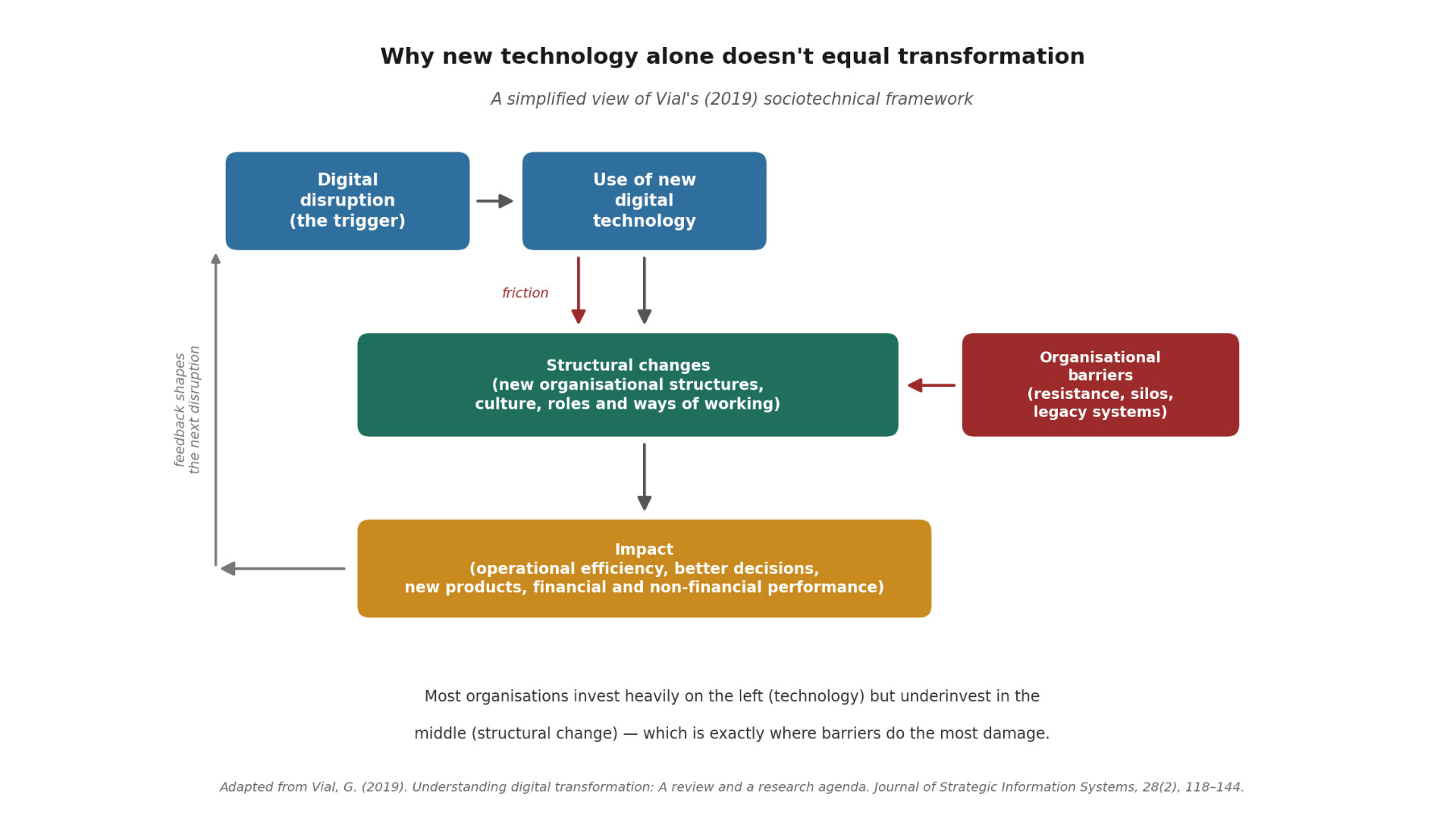
The first is Gregory Vial's sociotechnical model of digital transformation. Vial's review of the literature makes a simple but often ignored point: technology is only the trigger. Real transformation requires structural changes - new organisational structures, roles, and ways of working - sitting between the technology and any business impact. Most organisations pour investment into the technology itself and treat the structural middle as an afterthought, which is exactly where resistance, silos, and legacy processes do the most damage (Vial, 2019). Consultancy research converges on a similar findings. BCG Platinion’s analysis of large-scale transformations suggests that difficulties often arise not from the technology itself, but from disconnects between strategic goals, architectural decisions, and the structures responsible for delivering change (Hamane, Burchardi and Singh, 2026). This echoes Vial's point above: it is the structural middle, not the technology, where transformations most often break down.
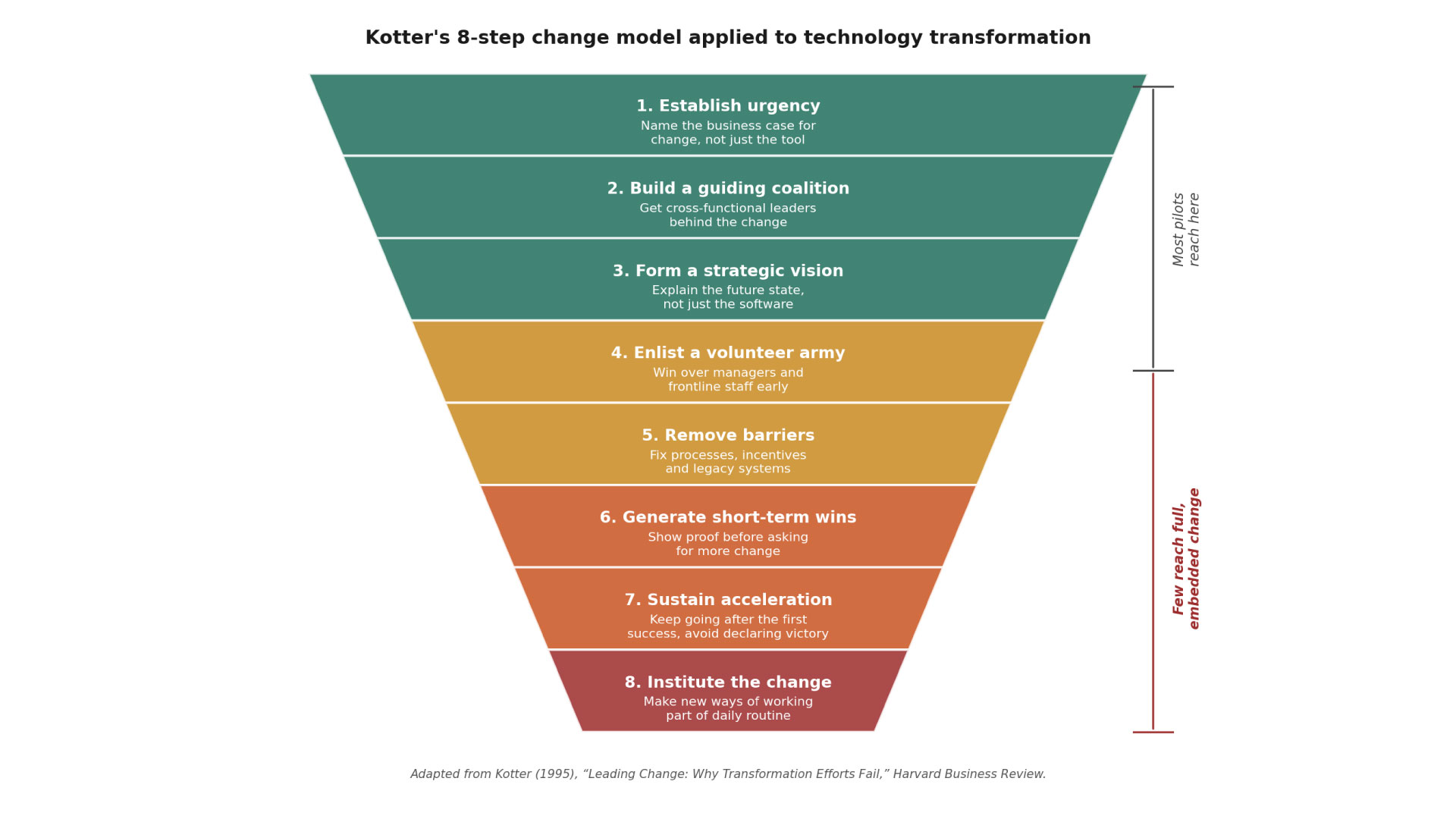
The second is John Kotter's eight-step change model, first published nearly thirty years ago and still strikingly relevant. Kotter studied over 100 companies attempting major change and found that most efforts stall not at the start but in the middle and later stages — after the urgency has been created and a vision announced, but before the change is actually embedded in daily habits (Kotter, 1995). This maps closely onto what both McKinsey and the UK government reviews found: it is easy to get an organisation “experimenting”; it is much harder to reach the later steps, where short-term wins are locked in and new ways of working become permanent.
What middle management can actually do
McKinsey's key finding is that success is driven more by which practices executives follow, than by industry, function, or the specific outcome targeted (sales growth, cost reduction, customer experience, etc.) (Bughin, Deakin and O'Beirne, 2019). This suggests that the technology itself isn't the differentiator but organizational discipline around how it's adopted provides the positive results.
For professionals sitting between the boardroom and the frontline, following practical moves follow from this evidence:
-
-
Clear, outcome-tied priorities: Companies that defined a few themes directly linked to measurable business outcomes were 1.7x more likely to beat expectations.
-
Treat the technology and the operating model as one project, not two: McKinsey cites one exectuive’s rule of thumb: “one executive noted that for every $1 spent on technology, $5 should be spent on people”.
-
Name a single accountable owner: One in six organisations surveyed by McKinsey had no clear leader for AI adoption - a governance gap that both the NAO and the UK's own digital government reviews also flag as a root cause of stalled transformation. Bughin et al (2019) found that every standout performer had a Chief Digital Officer, and having a Chief Analytics Officer showed a clear link to outperformance.
-
Committing time and money: Transformations were 1.5x more likely to beat expectations when digital enablement was a top priority for senior leaders, and 1.3x more likely when dedicated opex was allocated.
-
Empowering people at all levels: Holding people accountable to individual goals, and balancing individual with collective accountability all correlated with better outcomes.
-
Bank small wins before scaling: Kotter's research and McKinsey's data agree that declaring victory too early, or trying to scale before proving value, is one of the most common ways transformation efforts quietly die.
-
The bottom line
New technology rarely fails on its own merits. Often, it fails because organisations underestimate everything around it: leadership clarity, structural redesign, and the patient, unglamorous work of embedding change into how people actually work. The tools have never been more powerful. The organisational discipline to use them well remains the harder, and rarer, achievement.
Explore our MBA degrees to lead transformation with confidence
Technology alone rarely delivers meaningful change. Walbrook’s MBA degrees can help you build the strategic, leadership and decision-making skills needed to turn new ideas into lasting business impact.
-
Bughin, J., Deakin, J. and O'Beirne, B. (2019) Digital transformation: Improving the odds of success. McKinsey Quarterly, 22 October (accessed: 14 September 2026).
Hamane, H., Burchardi, K. and Singh, A. (2026) Why 70% of transformations miss the mark and how to fix them. BCG Platinion, 26 January (accessed: 14 September 2026).
Department for Science, Innovation and Technology. (2025a). State of digital government review
Department for Science, Innovation and Technology. (2025b). A blueprint for modern digital government
Kotter, J. P. (1995). Leading change: Why transformation efforts fail. Harvard Business Review, 73(2), 59–67.
McKinsey & Company. (2026). The State of Organizations 2026
National Audit Office. (2023). Digital transformation in government: Addressing the barriers to efficiency
Vial, G. (2019). Understanding digital transformation: A review and a research agenda. Journal of Strategic Information Systems, 28(2), 118–144
Related articles
-
MBA vs MSc: Making the right decision for your career
-

Is an online MBA respected in today’s market?
-

What is an MBA?
Why students choose Walbrook
-
Get a CMI-accredited MBA in as little as 1 year
-
Earn your MBA 100% online, around work and life
-
Competitive UK MBA tuition – just £8,880
-
Choose from 12 MBAs to match your career goals
-
Designed in London: UK capital of global business
-
Built around the Institute of Directors’ framework