hero-cluster-ai-degrees-walbrook

Artificial intelligence master’s degrees: 100% online

  • Begin within weeks – with 12 start dates a year.

  • Graduate in just 1 year – ready to work with current and emerging tech.

  • Developed in the heart of London – global hub for tech and innovation.

Explore our artificial intelligence master’s degrees

Artificial intelligence is creating opportunities well beyond one type of “AI job”. Organisations need people who can build and work with AI technologies – and people who can decide where they add value, lead their adoption and manage the risks that come with them.

At Walbrook, you can choose between two 100% online AI master’s degrees. Build computer science and technical AI expertise with our MSc Computer Science with Artificial Intelligence, or combine AI with business strategy and leadership on our MBA Artificial Intelligence. Study around your job, pay per module, and graduate ready to move into high-paid, high-impact roles.

Find an AI master’s degree

At Walbrook, we offer two routes into artificial intelligence – one for future leaders, one for technical specialists. Both 100% online, both start every month.

Get your master’s in Artificial Intelligence, the Walbrook Way

  • rating-star

    We're 12th in UK for employment and further study

    • Curriculum informed by our London location.
    • Career support via 24/7 online hub.
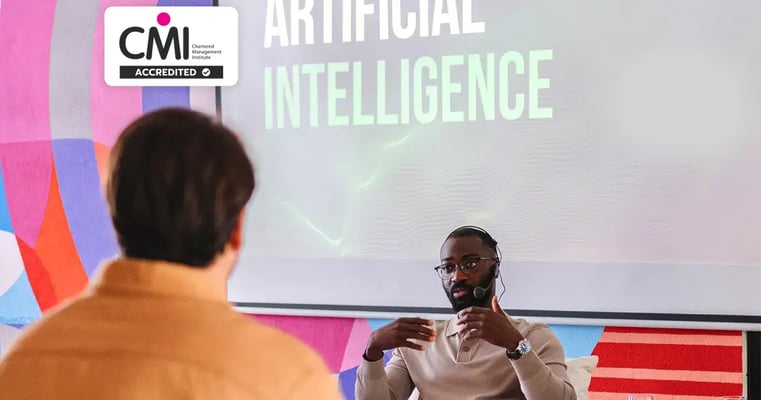
    • Our MBA AI is accredited by CMI.
  • laptop

    Study 100% online, from anywhere

    • Graduate in just 1 year.

    • 12 start dates a year – start within weeks.

    • Highly competitive tuition – from just £7,680.

  • people-man-graduate

    For AI professionals balancing work, home and life

    • Specialise in the #1 tech skills gap. 

    • Study flexibly within a weekly structure.

    • Flex between full and part-time.

Why study artificial intelligence?

AI skills are in growing demand across the UK – not only from organisations building AI, but from those looking for people who know how to apply it effectively. Here’s what’s driving that demand:

  • UK AI hiring is growing fast – employers advertised around 180,000 specialist AI roles in 2025, up from 112,000 in 2024 – an increase of 68,000 in one year (PwC UK AI Jobs Barometer, 2026).

  • AI is the UK’s biggest reported tech skills shortage – employers ranked AI as the technology specialism where they face the greatest skills shortage (Harvey Nash Tech Talent & Salary Report, 2026).

  • AI hiring increased across every UK sector analysed by PwC, with particularly strong activity in technology, media and telecoms, financial services and the public sector (PwC UK AI Jobs Barometer, 2026).

  • Generative AI Engineer was the fastest-growing global tech occupation in 2025, with Prompt Engineer third, based on LinkedIn job-posting growth (Harvey Nash Tech Talent & Salary Report, 2026).

hero-image-pdp-msc-business-and-management-AI_walbrook

Artificial intelligence salaries: what to expect

Demand for AI expertise is reflected in how much employers will pay for it. UK workers with specialist AI skills commanded an average wage premium of 34.2% in 2025, up from 11% the year before (PwC UK AI Jobs Barometer, 2026).

And demand isn’t only for people who build AI. Organisations also need professionals who can judge where it adds value, lead its adoption and make responsible decisions about how it is used – creating opportunities across both technical and business careers.

How much you can earn varies significantly by your role, experience, location, industry and employer. Technical specialists can command strong salaries, while senior AI strategy and transformation roles typically reflect substantial professional and leadership experience.

Artificial intelligence roleAverage UK salary*
Prompt engineer

£65,000 – £100,000

Artificial intelligence engineer

£65,000 – £100,000

LLM engineer

£60,000 – £120,000

Machine learning engineer

£70,000 – £120,000

AI architect

£70,000 – £110,000

Chief AI Officer

£125,000 – £250,000

*Average UK salaries from 2026 Tech Talent & Salary Report, Harvey Nash. 

Careers in artificial intelligence

Careers in artificial intelligence span technical development, wider computing roles and business leadership. Where you could go next depends on the experience you already have and whether you want to build AI technologies or lead how organisations use them.

  • Want to build specialist AI expertise? Roles such as AI Developer, Machine Learning Engineer and, with the right experience, AI Architect focus on developing, applying and integrating AI and machine learning technologies.

  • Want to build a career in tech and AI? You could work towards roles across AI, software engineering, data analysis and cloud computing while developing broader computer science expertise alongside your AI specialism.

  • Want to lead AI at an organisational level? With the right professional experience, you could progress towards roles such as AI Transformation Lead, Head of AI Strategy or Director of Innovation and Technology, taking greater responsibility for AI strategy, adoption and organisational change.

media-image-career-ai-strategy-lead

Which AI master’s is right for you?

MSc Computer Science with Artificial IntelligenceMBA Artificial Intelligence
Best for

Career changers, graduates and professionals who want to build technical computer science knowledge alongside specialist AI skills. You do not need a previous computer science degree.

Professionals who want to understand AI in a business context and develop the strategic, management and leadership skills to help organisations use it effectively.

Focus

Building knowledge across programming, software, databases, networks and cloud computing, while specialising in machine learning, large language models and other AI technologies.

Exploring how AI and machine learning can support business decisions, while developing wider expertise in strategy, change management, marketing, HR, finance and business intelligence.

You'll graduate ready to:

Explore roles involving AI development, machine learning and wider computing, such as AI Developer, Machine Learning Engineer and, with relevant experience, AI Architect. The wider curriculum can also support paths in software engineering, data analysis and cloud computing, informed by AI.

Explore roles involving AI strategy, transformation and technology leadership, such as AI Transformation Lead, Head of AI Strategy or Director of Innovation and Technology, backed by your studies as well as professional experience.

Prior tech experience?

No computer science degree required: programming and wider computer science skills form part of the degree.

No specialist AI or computer science qualification required. The emphasis is on combining your professional experience with business, management and AI learning.

Explore the programme

Still not sure?

Tell us what you're thinking about and we'll help you choose – request information for a callback, or call us on +44 2074 447 103.

Why choose Walbrook for your online Artificial Intelligence degree

Choosing Walbrook means studying an AI master’s that’s built around you – your goals, your schedule and the direction you want to take your career. Choose a technical or business-focused route, with the flexibility to study on your terms and support to help you keep moving forward.

  • 12th in the UK for careers – dedicated careers support, CV reviews, and our 24/7 Careers Hub.

  • Complete your master's in just 1 year – or study part-time to fit learning around your work and personal commitments.

  • Choose the AI route that fits your goals – build technical AI and computer science expertise with our MSc, or develop your AI-focused business and leadership skills with our MBA.

  • Competitive tuition: from £7,680 – pay per module, or in-full at the start of your studies.

Woman giving a presentation in front of a large screen

FAQs about studying an artificial intelligence master's

Contact us about our online degrees

Any questions about our online degrees or studying at Walbrook? Our Enrolment Advisors are here to help.

Our office is open Monday to Friday from 8.00am to 5.30pm UK time (excluding UK public holidays).

*National Graduate Outcomes Survey, 2024