
How fraud exploits human psychology
Fraud is always with us. The ‘three shell game’, for example, is thousands of years old. Should you not yet have encountered it, a trickster invites people to bet that they can guess under which of three small containers a ball is hidden. They shuffle the containers around in front of their victim, and maybe even let them win a few times, before using sleight of hand to ensure they lose.
The three-shell game remains popular with fraudsters, though it’s banned in most countries, because, like all successful frauds, it plays on some basic human instincts including trust.
About the expert:
Phil Corr, Professor of Psychology at Walbrook Institute London, explains the psychology of the scam, gives some examples of how it works in practice and advises on the one sure way to avoid getting duped.
Philip Corr is Professor of Psychology at Walbrook Institute London, Emeritus Professor of Psychology at City St George’s, University of London, and past Honorary Professor of Psychology at Brunel University. He has published over 200 scientific papers and over ten books. He is also a Fellow of the British Psychological Society (BPS). Previous work has included working with Kent Police on their degree apprenticeship education programme where, among other topics, he taught the psychology of fraud.
Fraudsters are not alone in using psychological ploys. Every effective commercial firm does it. What makes fraud different is that it is misrepresentation for gain. Behavioural economics may help firms persuade people to part with their money, but the customers will get the product or service that they expected. If they don’t, they can get their money back. Fraudsters don’t offer refunds.
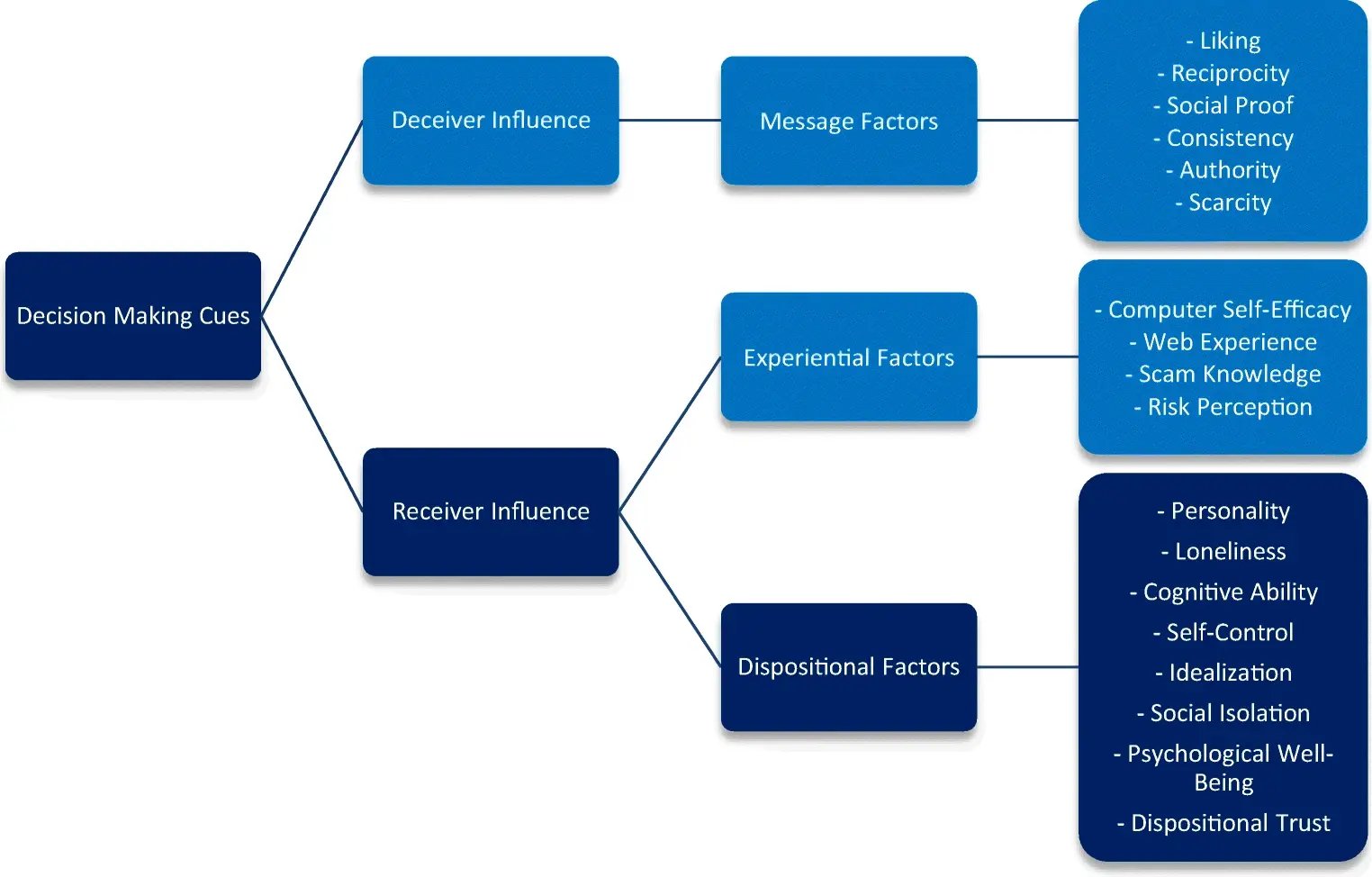
Not all frauds work the same way. What makes them successful is when the messaging used by the fraudster can exploit the disposition of the victim, as outlined in the diagram below*.
*Source: Norris, G., Brookes, A. and Dowell, D. (2019)
The Psychology of Internet Fraud Victimisation: a Systematic Review
Journal of Police and Criminal Psychology, 34, 231–245. Figure 2. Licensed under CC BY 4.0. No changes made.
The traits and behaviours scammers exploit
Fraudsters look to exploit vulnerabilities. These are not necessarily weaknesses in the way that most of us would understand. On the contrary, they are often what are regarded as social virtues. In particular, fraudsters will target people who have an agreeable and trusting nature as well as those who prefer to see others as honest and straightforward (that is, those who believe that people get what they deserve, that the world is just).
For obvious reasons, fraudsters aim to ensure that people do not understand that they are being manipulated. For example, they will seek to put targets under time pressure to act, which stops them considering what is really going on. Pressure inhibits rational decision making. It also helps fraudsters if people are socially isolated and looking to be part of a wider community – something that cults make use of. And, if potential victims are not aware of how prevalent fraud is, so much the better.
Most of us tend to think that we could not be conned. The reality is that most of us could or already have been. Among countless others, I know I have been. The reason why is that, in exploiting others, successful fraudsters can rely on fundamental aspects of human nature. For example, they lean into our responses to likeability, reciprocity, social proof, consistency, authority and scarcity – just as honest commercial firms do. Who has never bought something just because the marketing was good?
What it looks like in practice
What does the work of scammers look like in practice? To boost likeability, fraudsters present as a pleasant person, perhaps one who resembles a family member such as a grandchild, much as a salesman will often be young, smiling and neatly dressed in a suit.
They will try to exploit reciprocity – after all, it’s only polite to return a favour – by providing a small benefit and trying to extract a large one in return. This is analogous to the way that retailers seek to encourage loyalty with reward cards.
Advertisers often use social proof – the idea that ‘people like you are doing this’. We’ve all seen ads with ‘housewives’ extolling the benefits of a brand of washing powder. In the same vein, online fraudsters might show us young men who have bought an expensive car after ‘investing’ in a new meme coin.
‘Special’ investment opportunities around technology give fraudsters the opportunity to appear as providers of expert knowledge, just as, say, regulated cosmetics firms will unveil a new skincare formula that involves lots of scientific formulas. Having, or appearing to have, expert knowledge can encourage a certain course of action. After all who likes to think they’re missing out on a great new thing?
The ‘expert knowledge’ approach can often overlap with creating a sense of scarcity, such as the claim that ‘only a few people know about this’. When a low-cost retailer says, ‘grab it, or it’s gone’, they are clearly exploiting our desire to not miss out, or to get something that others might not, but it will also be true that stocks are low. When a fraudster does it, there is no need to rush.
Payment scams are on the rise
Scams – particularly online – are a significant social problem and a particular burden for payment service providers. Since October 2024, payment service providers in the UK’s faster payments system have been required to reimburse those caught out by authorised push payment scams by up to £85,000 a claim, unless there has been “gross negligence”. In response, banks have stepped up their work on detecting and preventing fraud.
For example, they now co-operate more closely with telecom operators to monitor patterns of fraudulent activity and payment apps are carefully designed to discourage over-hasty use of faster payments. PSPs can also delay and investigate faster payments if they suspect fraud or dishonesty.
A July 2026 report by Frontier Economics, commissioned by the Payment Systems Regulator, found that “[authorised push payment] fraud has fallen by an average of £6.1 million per month or 21 per cent since the reimbursement requirement”, or by £73 million per year. UK Finance is less sanguine. In June 2026, its annual fraud report said that authorised push payment fraud rose in 2025 by 19 per cent to £576.4 million. The difference between the two findings is said to be down to UK Finance using figures from the date the claim was closed by a PSP, whereas Frontier Economics looked at scams when they happened.
Bank accounts are safer, consumers are not
But there is another way of looking at the data:
"Every scam that requires technical access to a bank account is declining,” James Roche, Fraud Consultant at FICO, said in a statement. “Every scam that requires psychological access to a person is accelerating. This is because fraud prevention systems were designed to detect unauthorised access. Now, they need to identify people who are being tricked in real time.”
This is reflected in the numbers reported by UK Finance. It found that, for authorised push payment fraud, purchase scams were 71 per cent of cases and up 20 per cent to £118.1 million. Investment fraud was up 40 per cent to £221.5 million, with case numbers up 26 per cent, and romance fraud was up 23 per cent to £39.2 million, with case numbers up 22 per cent. The only fall was in ‘impersonation fraud’, where criminals pose as a bank, the police or another trusted organisation and ask for the transfer of money to a “safe account”. There, losses were down 12 per cent and case numbers down 11 per cent. This is largely due to many banks adding app features that allow people to check in real-time whether a call is really from their bank. That is, there is a technical fix. Protection doesn’t rely on people resisting psychological tricks.
There are more risks online
Does being online, as opposed to dealing with people face-to-face, lead to greater fraud susceptibility? After all, for most frauds to work, the victim has to play at least some role in it: engage with the fraudster, provide information and hand over money.

Interacting online does have different psychological dynamics to face-to-face interactions. When dealing with people face-to-face, for example, we can pick up on non-verbal clues such as body language, which help us understand someone’s real intentions. We’re also more likely be more focused and to pay more attention when we’re not using a screen, because we’re not distracted by the technology.
Online, persuasive ploys can be more effective because we have less experience of interacting in this environment and may get confused – cognitively overloaded – by the fraudster. For example, tactics like time pressure can get the victim to undertake an action they might not even consider in a face-to-face interaction. Fraudsters can also appear more polished and convincing online as they are following a script.
Everyone is vulnerable
Some research has suggested that certain groups are more susceptible to scams, particularly the middle-aged (who tend to have more money). However, there’s little evidence to suggest that one group is more vulnerable than another.
We’re all potentially victims, even when we think we are not, because successful fraudsters are aware of the psychological vulnerabilities associated with any group of individuals.

For example, ‘Bernie’ Madoff used affinity fraud, targeting his religious community, because they were more likely to trust him than an ‘outsider’. He further boosted that trust in what turned out to be the biggest Ponzi scheme to date by refusing to take their money, saying his investment fund was exclusive (scarcity, again).
Always say ‘not now’
How can people protect themselves from scammers – online and off? First, anyone who receives an email, or message, that seems suspicious should just delete it. If a phone call is unexpected and seems off, they should hang up.
Unwanted emails, messages and calls can all be blocked and reported to the email or phone provider or to Report Fraud (formerly Action Fraud).
Anyone who finds themselves faced with a request for money or information online, even if they are dealing with people they feel they have come to know, should always say, “Not now, I’ll think about it. I won’t make any decision before tomorrow.” This is imperative. No legitimate business, and no honest person, will try to put someone under immediate time pressure to make a payment or disclose important information. Never.
If saying ‘not now’ sounds excessively polite, we should all remember that scammers are dangerous criminals. Many operate as part of crime rings with extensive resources, including the resources to coerce people into scamming others. They often gather a lot of information about the people they target and can retaliate if someone tries to teach them a lesson. Attacks can include identity theft, online harassment (including of friends and family), and even physical assault.
‘Not now’ is always the best way to say, ‘not ever’.
Explore psychology in more depth with Walbrook
From fraud and decision-making to mental health, education and behaviour, psychology helps us understand why people think and act the way they do. Explore our online MSc Psychology programmes and find the route that fits where you want to take that understanding next.
A version of this article was originally published in Financial World Magazine, from LIBF (part of Walbrook).
Related articles
-
What is an MSc in Psychology?
-

How much does psychology make? Highest-paying psychology jobs
-

Psychology books to read if you're a psychology fan